
Why Architects Should Master Construction Cost Estimating
It is easily achievable and it enhances your reputation
A Cost Estimating Lesson From County Government
I once had the chance to work for a county government. They had no money. Every nickel of tax income was allocated. However, the head commissioner was a genius at finding money. He made it very clear to me with every new project that it was not acceptable to go over budget because there simply wasn’t any more money.
If I wasn’t up to the task of managing the project budget, it would have been a ‘one and done’ situation. As it was, we did a project a year for the head commissioner while he was in office.
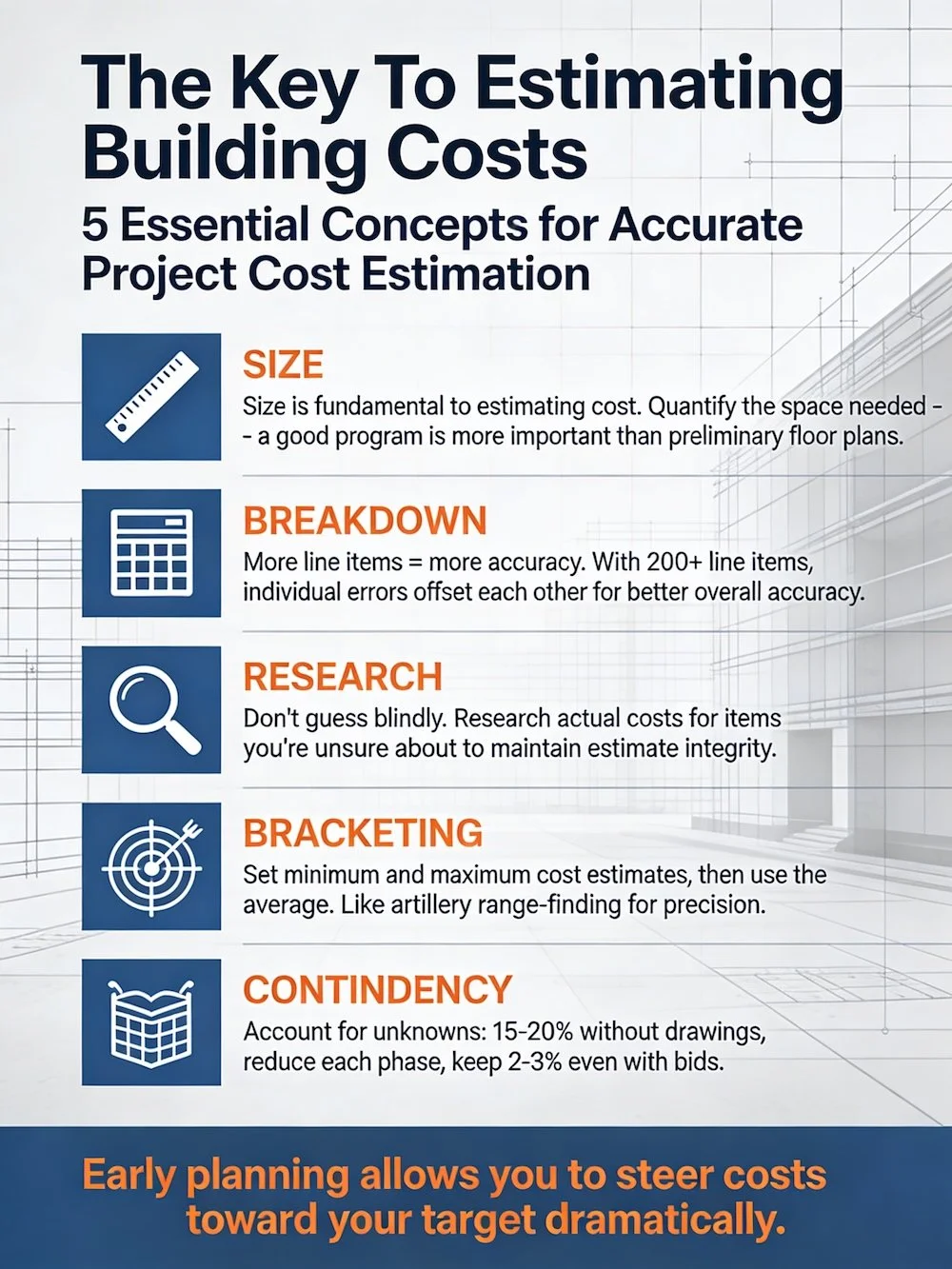
Mastering Construction Cost Estimating Depends On Just Five Issues
Include as many line items as you can
Zero in on the real size
Research any unknowns
Bracket the range of unit costs
Always include a contingency
More About The Five Cost Estimating Issues
Size, breakdown, research, bracketing, contingency are the five issues that every cost estimate depends on. You can master these five issues in almost the time it takes you to read The Key To Estimating Building Costs. There is a little bit more to it than that, but we are talking about a very short learning curve to get to top notch results. I will expand on each issue below, but first let’s briefly look at why accurate estimating matters.

Why Accurate Construction Cost Estimating Matters
Why Budget Accuracy Matters to Every Client
No matter how much money your client has, they will not like the nasty surprise of having to spend more than you said it would cost.
If you are wildly off, and it is almost a law of nature that you will be over budget rather than under budget, then the project may be cancelled or scaled back. Your client may not want to pay you for your work.
Even if you are working for someone who truly has unlimited resources, they would rather say that you are a genius when it comes to cost estimating rather than admit that they hired an idiot who missed the mark. Your performance reflects on them, too.
The Professional Cost of Going Over Budget
It is awkward for you.
How will your client take the news?
At the very least your relationship with your client is strained.
It is awkward for them.
How will their boss/board/banker take the news?
At the very least it creates some extra work/meetings/calculations - because of you.
The Key to Accurate Construction Cost Estimating
Are you ready to hear the secret to cost estimating? …lots of line items.
That’s it.
The More Line Items In Your Construction Cost Estimate The Better
The more line items you have, the more accurate your estimate will be. This rule of thumb indicates that the worst way to estimate costs is Cost Per Square Foot For Your Building Type. One line item. I estimate that your chance of being within 10% is … 10%.
Being detailed by using lots of line items is not the whole secret, but it is the important bit. And being comprehensive shouldn’t focus on only construction. The link at the beginning of this paragraph explains the value (magic) of more line items
Include All Project Costs in Your Estimate
My experience is that most clients are novices at design and construction and have no idea what is involved. This is your opportunity to demonstrate your expertise by being comprehensive in your cost estimating by including everything - construction costs, design costs, and project costs. The link above will explain how to be comprehensive.
The Size Of The Project Impacts Your Estimate
It is important to do reasonably accurate takeoffs. With some CAD/BIM systems this can be a breeze. If you have to do it old school, just knuckle down and do it.
But there is another way that size is important.
Very small projects need extra attention. Mobilization costs are included in published unit costs. But - they assume a standard size project. When the project is very small the mobilization cost that is buried in a standard project unit cost might make the unit cost on a small project two to ten times as much. If the whole project is small, this issue is a really big deal. To maintain accuracy you will have to go deeper than published unit costs and research labor, materials, overhead, etc.
Research The Unknown Items Of The Estimate
Occasionally you can’t find unit cost data for a component. An example might be custom, textured, concrete, exterior walls. What it takes to achieve what you want may be many times more expensive than the form liners you think are similar. Ask somebody that knows what it will take. The difference between reusable, standard form liners and a custom design that can only be used once could be a 1500% error.
Bracket The Unit Costs Of The Estimate
This is similar to Researching The Unknowns. If you are looking at unit cost data and can’t decide which is most appropriate, use the average of the high and low unit costs.
Use A Contingency In Every Estimate

No matter how many line items you have, weird stuff can happen. Your defense is to include a contingency for these unknowns and weirdness. There are two approaches that I have used. Make the contingency a line item so it is obvious. At least half your clients will immediately subtract it from the bottom line.
My preferred method is to make it a line item that shows the percentage contingency that is included. Then each line item is increased by this percentage. Your spreadsheet is a bit more complicated, but the contingency is not such an easy target for those clients that like to make things political.
The size of the contingency matters. I use up to 25% when the estimate is based on no drawings. By the time you get finished with construction documents, you might be down to 5% or less.
Mastering Construction Cost Estimating
Setting Client Expectations on Construction Costs
A component of mastering cost estimating is setting expectations. Even the experienced client can benefit from clearly set expectations. For various reasons your client may resist having every single cost delineated on a spreadsheet. This resistance without a reasonable explanation may be a warning sign that the finances that everything depends upon may not be up to the challenge. Being too pollyannish can hurt someone. It could be you when the project is cancelled or scaled back. Or it could be the client getting hurt by spending money on a lost cause.
When you do an accurate estimate, you are creating a view into a future reality. If the cost is too high, the proper response is to reduce the scope of the project. I like to resolve this as early as possible, say Pre-Design.
Follow The Process
There is no magic involved, just follow the process. Avoid embarrassment. Bask in the glow of the professional’s expertise. Remember. Use lots of line items. Adjust for size. Research unknowns, Bracket unit costs. Always include a contingency. When presenting your estimates, be comprehensive, and set expectations.
Architects are often portrayed as irresponsible when it comes to cost; developing a process for estimating construction cost sets you apart from the crowd. Since it is easy, in no time you will be an expert at estimating construction costs.
On your next estimate, start building your estimating process and your reputation for knowing how to manage costs.
