
Construction Administration Economics for Architects

The Construction Administration Phase is different because there are more circumstances beyond the Architect’s control. This is especially true when the contractor is not top notch. You need construction administration fee protection to prevent the construction administration hours from getting excessive. Here is a description of the problem and what to look out for to prevent a CA phase fee loss for the architect. Take a look at how to bill for construction administration services and download a helpful spreadsheet.
Construction Administration Economics
The Construction Administration [CA] Phase has many more influences beyond your control, so it requires special attention when planning your architectural fee.
Why Construction Administration Loses Money for Architects
The main reason is that most small contractors are not very competent at building effectively.
This hasn't always been the case. Prior to 1980, the superintendents and project managers in modest sized construction outfits were often more experienced than the architectural staff and could be counted on to do it right.
The only place I find that type of person these days and for the past two decades is in a construction management firm that negotiates, not bids, its work. Many developers have similar capabilities. If your contractor came to you by way of a public or open bidding process, you should expect the worst. You won't be disappointed.
The Problem with Low-Bid Contractors
Ignore the specs - They became the low bidder by planning to do something different than required by the project documents. It can be conscious or unconscious, but that is now a problem they have to overcome.
Substitutions - One solution to their problem is substituting cheaper labor and materials than specified. Cutting corners becomes a focus. They want to do lots of things differently.
Lacking knowledge - It is not uncommon for the low bidder to be in over their heads. They may not understand what is required, or know how to do it.
Making mistakes - You can count on the low bidder making mistakes: wrong placements; wrong materials; wrong dimensions; missing substrate.
Low bid often means they didn’t understand the requirements. How bad can it become?
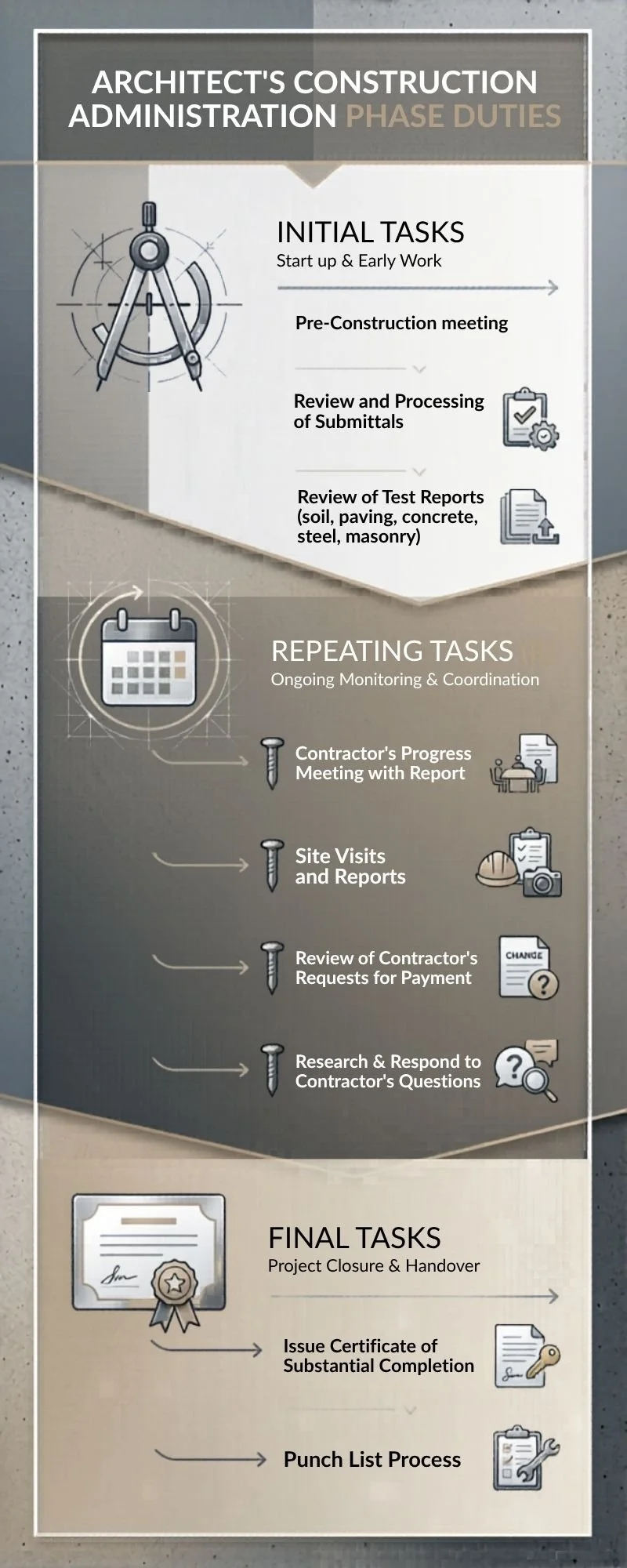
The Hidden Cost Multipliers
If you are a capable architect, this is an aggravation, but mostly it is a financial problem. The reason is that you will burn through your fee at two to three times the rate that the standard AIA contract anticipates. Every misstep by the contractor is extra hours for you.
Submittals - The low bidder’s best way to make up for his too-low bid is to shop around for cheaper subcontractors and materials suppliers. During this process, the project’s specifications go out the window. You will have to research why the submittal doesn’t meet specs, do the paper work and then deal with additional submittals for the same thing.
Site visits - You will need to visit the site more often than you planned on to see that corrections are made before they are covered up. You will also find that some of the rejected submittals are being implemented nonetheless. More Field Reports, more time.
RFIs - The Requests For Information may be formal or they may be phone, email, texts. But there will be a lot of them. More than you planned for. The project superintendent is invariably young and inexperienced.
Punch List - One of the hallmarks of a sub-standard contractor is his tendency to make any corrections later. It is almost always harder to correct later. The result is that you will make multiple punch list visits (and punch list updates) to resolve a very long list of issues.
Close Out - An inexperienced contractor will have trouble gathering everything required for Close Out. When you get it, the documents will be incomplete. More time for you to straighten things out.
If you choose not to put out the extra effort, you risk an unhappy client and additional liability. Even if your documents are air-tight, you can find yourself being sued. You probably won't have a judgement against you, but you will use up your professional liability insurance deductible and plenty more before you are able to make your case.
The Fix: Cap Your CA Hours in the Contract
Here is how to bill for Construction Administration. The standard allocation of fees just isn’t adequate. The solution is to limit the CA hours in the architectural fee and to establish an hourly rate fee that will take effect once those hours are exceeded.
That’s it. Now you are protected against construction ineffectiveness.
You will need to modify standard contract language to implement this. Your fee proposal should introduce the idea as a built-in provision for a common Additional Service.
Free Download: CA Economics Spreadsheet
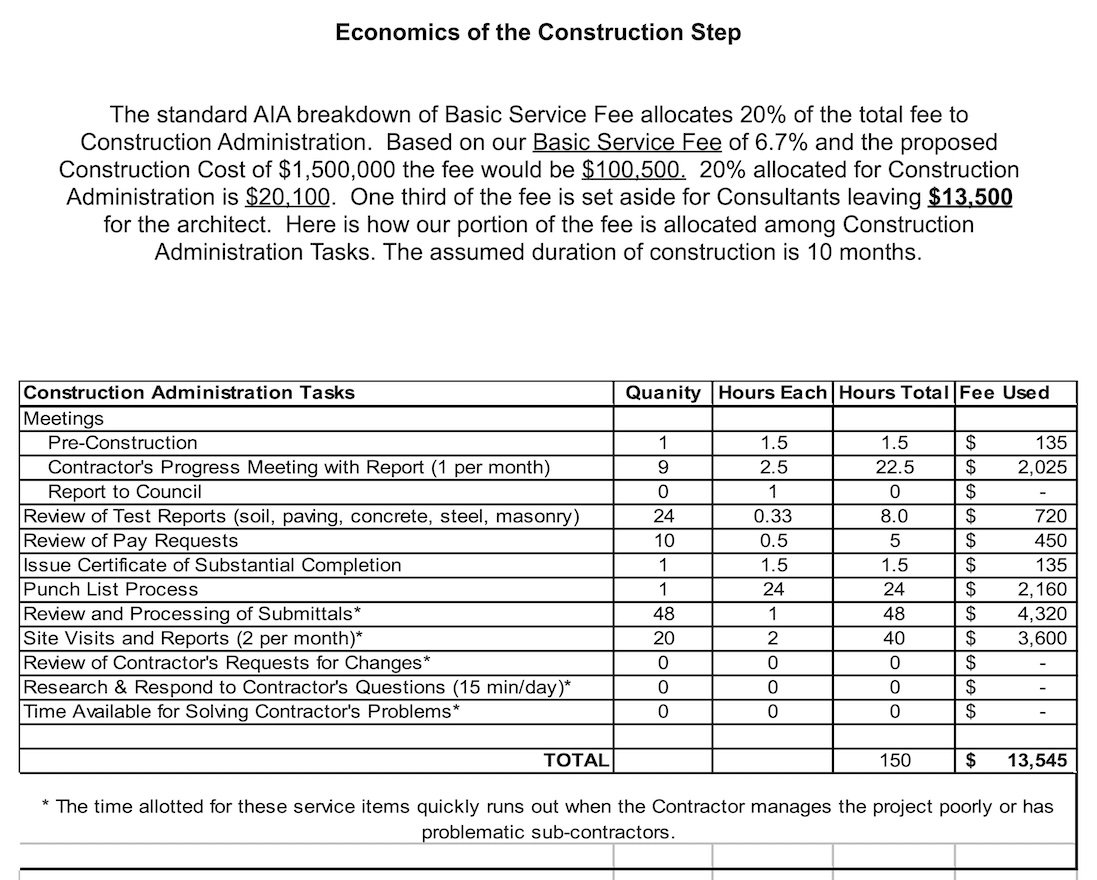
It is way better to do an outstanding job of Construction Administration. And get paid for it by setting a limit on the number of hours that the Construction Administration portion of the fee includes. After all you do not have controll over this part of the project.
Download the CA Economics Spreadsheet
Download the CA Economics Spreadsheet that we prepared to make our case to a client. We referred to and paraphrased it in our proposals and contracts. Recreate it to suit your standard practices to protect yourself on future projects.
Remember, when working on the CA fee, think about the things you want in the scope of CA services.
FAQs
What does the Architect do during the Construction Administration Phase?
See this guide to Construction Administration for a complete breakdown of tasks.
How many CA hours should I include in my fee?
My rule-of-thumb is two hours per week for the expected duration of construction. But the answer I get by using the spreadsheet is always different. ❌
What’s a typical CA phase percentage?
Historically the percentage of the fee set aside for CA has been 20% of the Basic Services Fee.
How many submittals are typical?
Submittals are shop drawings, samples, material spec sheets, and test reports. My rule-of-thumb is one submittal per spec section required by the project.
